The free guide Chapter 10 of 10 ~4 min read
Conclusion: Your Path Forward
Daniel and Maria five years on, the four stages of financial maturity, a 30/90/365-day action plan, and the questions that shape your next phase of growth.
Five years after modernizing his approach, Daniel's contracting firm had transformed. Revenue topped $15 million, his fleet and technology were upgraded, his real estate loan was refinanced at a lower rate, and his line of credit — expanded from $1 million to $2 million as the company's track record grew — provided steady liquidity. His personal guarantee was partially released. When a national general contractor delayed a multimillion-dollar payment, Daniel didn't panic: his 13-week forecast showed he could absorb it, his banker already knew, and his reserves were ready. Five years earlier, Daniel was managing projects. Now he was managing capital.
Maria's transformation was quieter but just as real. The owner who once took a triple-priced online loan in an afternoon now runs a $750,000 borrowing-base line at a bank that competes to keep her. Her suppliers report her early payments to the bureaus, her Paydex sits above 85, and her Monday morning starts with a 13-week forecast. Nothing about her industry got easier. She just stopped being surprised by her own business.
You Now Have the Framework
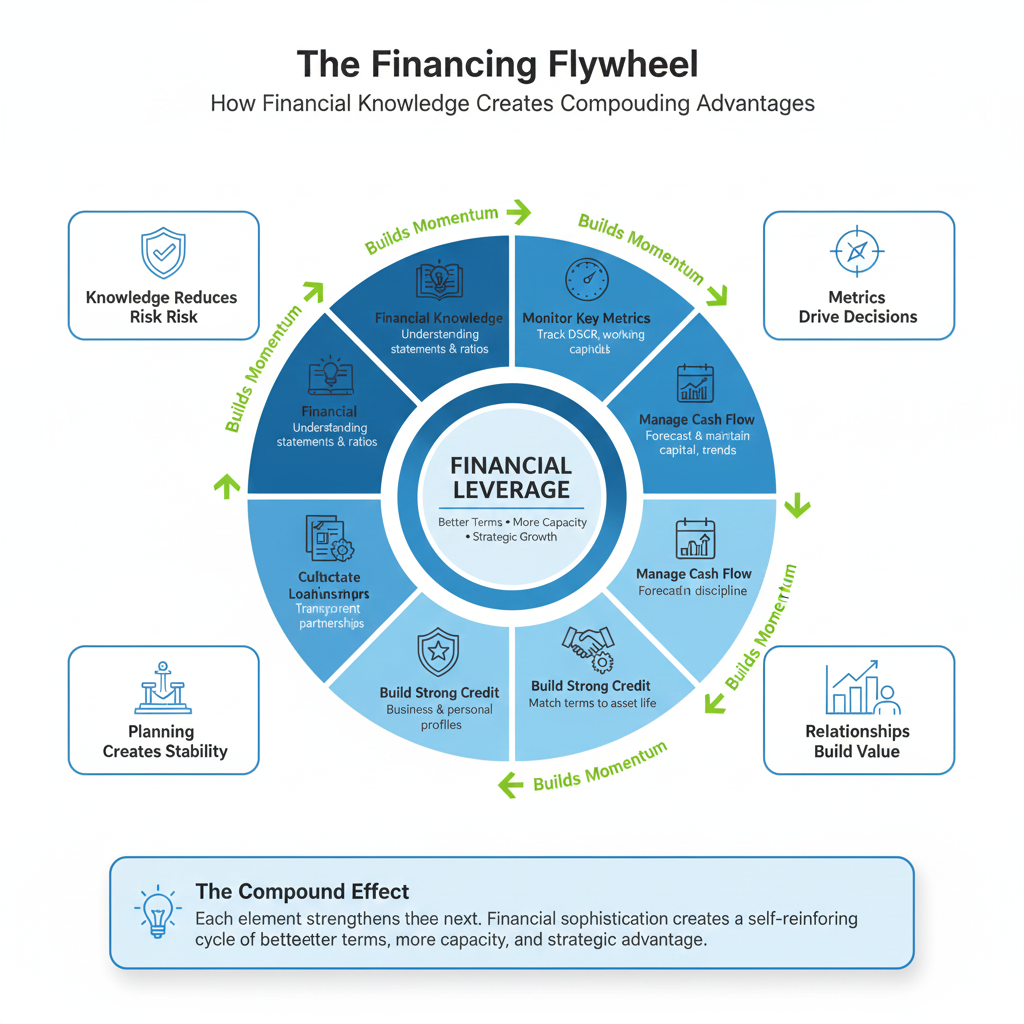
Across these chapters, you've built a banker's understanding of your own company. You've learned how to:
- Read your financial statements the way a lender reads them — and keep them clean enough to earn better terms.
- Monitor the handful of ratios that determine your borrowing capacity, and move them deliberately.
- Manage cash flow with forecasting discipline, so profit and liquidity stop being strangers.
- Build business credit that stands on its own — and shrink your personal guarantee over time.
- Order confidently from the financing menu: the right product, the right lender, honest pricing.
- Structure loans and covenants around your business — and navigate the application from package to funding.
- Build a banking relationship that shows up for you on your worst day, because you built it on your best ones.
The Four Stages of Financial Maturity
Most businesses climb the same ladder. Locate yourself honestly:
- Reactive. Financing happens in emergencies. Statements exist for taxes. The bank is a counter you visit when something breaks.
- Organized. Books close monthly, statements are clean, debts are documented. You can produce a lender package — it just takes a week.
- Predictive. A 13-week forecast runs weekly. Ratios are tracked. Renewals are calm. Your banker hears from you quarterly and is never surprised.
- Strategic. Capital is planned 24–36 months out. Facilities are sized ahead of growth, structures negotiated rather than accepted, and financing decisions are woven into strategy — bidding, acquisitions, succession.
Every chapter in this book moves you up one rung somewhere. The distance from Reactive to Predictive is smaller than it looks — for most companies it's a few disciplined quarters, not years. Daniel made the climb in two. Maria did it in three while doubling revenue.
The Competitive Advantage of Financial Maturity
In competitive markets, the companies that thrive aren't always the ones with the best products — they're the ones that manage capital most effectively. Manufacturers finance production cycles to fulfill larger contracts. Contractors leverage strong balance sheets and bonding capacity to win public bids. Distributors use credit strength to buy better and grow faster. Professional service firms acquire competitors. These aren't risky moves — they're the rewards of disciplined capital management.
Your Action Plan
| Horizon | Actions |
|---|---|
| Next 30 days | Pull your business credit reports (all three bureaus). Calculate your DSCR, current ratio, and leverage. Build week one of a 13-week cash forecast. Assemble a lender-ready folder: statements, tax returns, debt schedule, agings. |
| Next 90 days | Make the forecast a weekly habit. Fix your biggest cash-cycle leak (collections cadence, billing speed, or supplier terms). Send your banker current financials with a summary note — unprompted. Review every loan for maturity dates, balloons, and covenant cushion. |
| Next 12 months | Convert key vendors to reporting trade accounts. Close books monthly by a fixed date. Hold a strategic review with your banker: capital needs 24 months out, PG reduction, line sizing. Revisit your ratios quarterly and track the trend. |
The Banker's Final Perspective
As bankers, we lend to companies that plan ahead, communicate clearly, and demonstrate consistency. Strong borrowers don't just manage numbers — they manage relationships, risk, and opportunity. The best clients turn every loan into a tool for growth and every banker into a long-term partner.
Financial sophistication doesn't mean complexity — it means control. It means knowing where you stand, where you're headed, and how to use capital as leverage instead of limitation. That's the whole book in one sentence. Now go run your numbers.
Key Takeaways
- Financial literacy and liquidity discipline drive mid-market success — and both are learnable.
- Climb the maturity ladder: Reactive → Organized → Predictive → Strategic. Most of the value is in the first two moves.
- Treat your banker as part of your financial team, not a gatekeeper.
- Preparation turns financing from a necessity into a strategic weapon.
- Manage capital deliberately, and you'll never be controlled by it.
Questions to Ask Yourself
- What is my three-year capital plan — and how much funding will it require?
- Which area of my financial structure (ratios, cash flow, credit) needs strengthening first?
- Where am I on the four-stage maturity ladder — and what single habit moves me up one stage?
- Does my current banking relationship align with my next phase of growth?
- What's my plan for reducing reliance on personal guarantees?
- If capital were no longer a constraint, what growth opportunity would I pursue immediately — and what's actually stopping me from preparing for it now?