The free guide Chapter 5 of 10 ~7 min read
Understanding Credit and Building Business Credit
How business credit is built and scored separately from your personal credit, and what a lender is really checking before they say yes.
After several years of steady growth, Daniel's company was ready for its biggest move yet — purchasing a $3 million owner-occupied facility to consolidate operations. His banker congratulated him on a solid balance sheet and strong cash flow, but flagged one issue: the company's commercial credit history was thin. Everything had always been personally guaranteed. To reach the next level of autonomy and pricing power, Daniel needed to build his business's own credit identity — separate from his.
Two Credit Files, One Decision
Every owner actually has two credit stories. Your personal credit — the FICO score attached to your Social Security number — follows you everywhere, and for most loans under a few million dollars, banks will look at it no matter how strong the business is. Your business credit — attached to your company's EIN — is a separate file most owners have never seen, built from how the company pays its vendors, lenders, and cards.
Early on, the two are tangled: the business borrows on the owner's signature. The goal over time is separation — a company that is bankable because of what it is, not because of who owns it. That shift is what unlocks better pricing, higher limits, and eventually a lighter personal guarantee. It's also what makes your company sellable: a buyer wants a business whose credit doesn't walk out the door with you.
Why Credit Matters for Established Companies
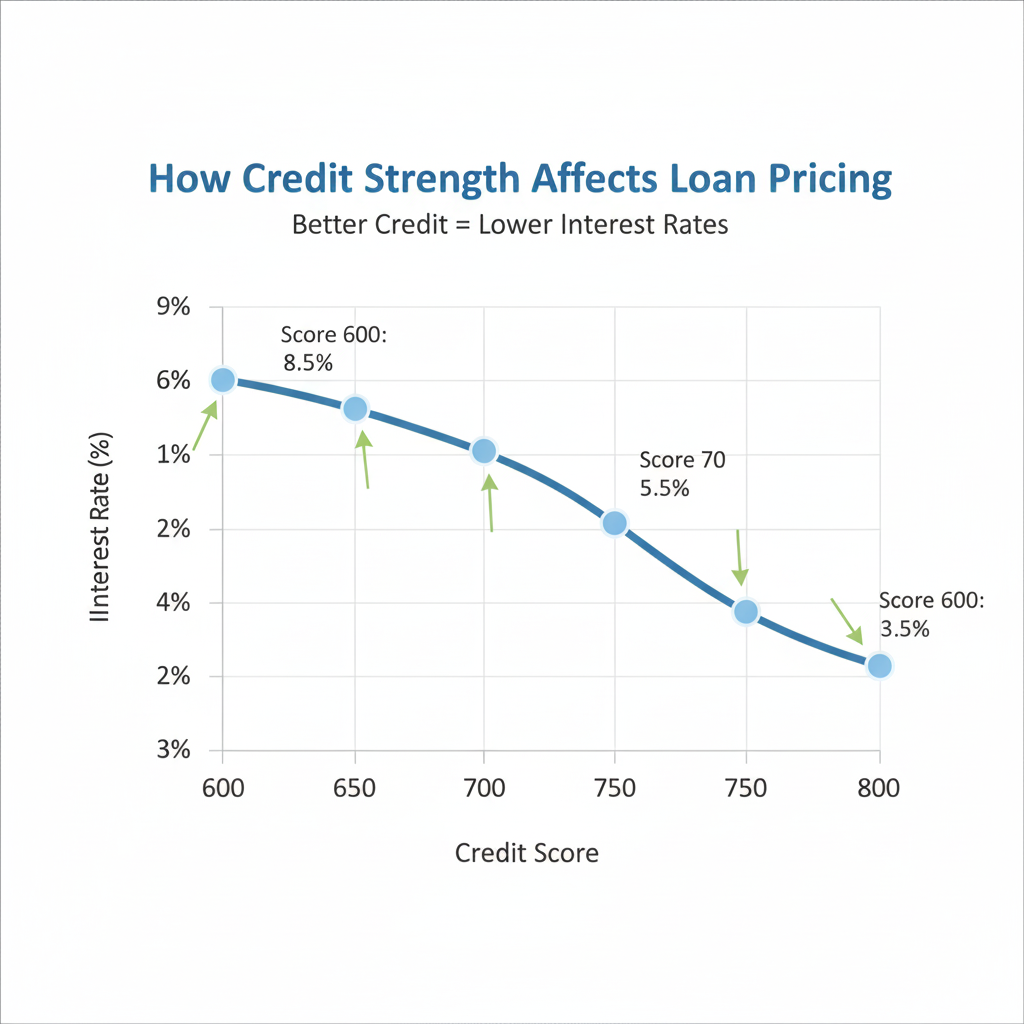
For a business past the startup stage, credit isn't about access — it's about cost, flexibility, and negotiating leverage. A company with a mature credit profile pays less for capital, negotiates better vendor terms, and moves through renewals faster. Credit depth literally saves basis points — and basis points are real money.
Example: a borrower with a D&B Paydex of 85+, an Experian Intelliscore of 80+, and a strong Equifax Business payment index may receive a 7.00% rate on a 5-year term loan. An otherwise identical borrower with weak business credit might pay 8.75% and face full personal guarantees. That spread — 175 basis points — equals roughly $50,000 in additional interest over the life of a five-year, $1 million loan. Same business, same collateral. Different file.
The Business Credit Ecosystem
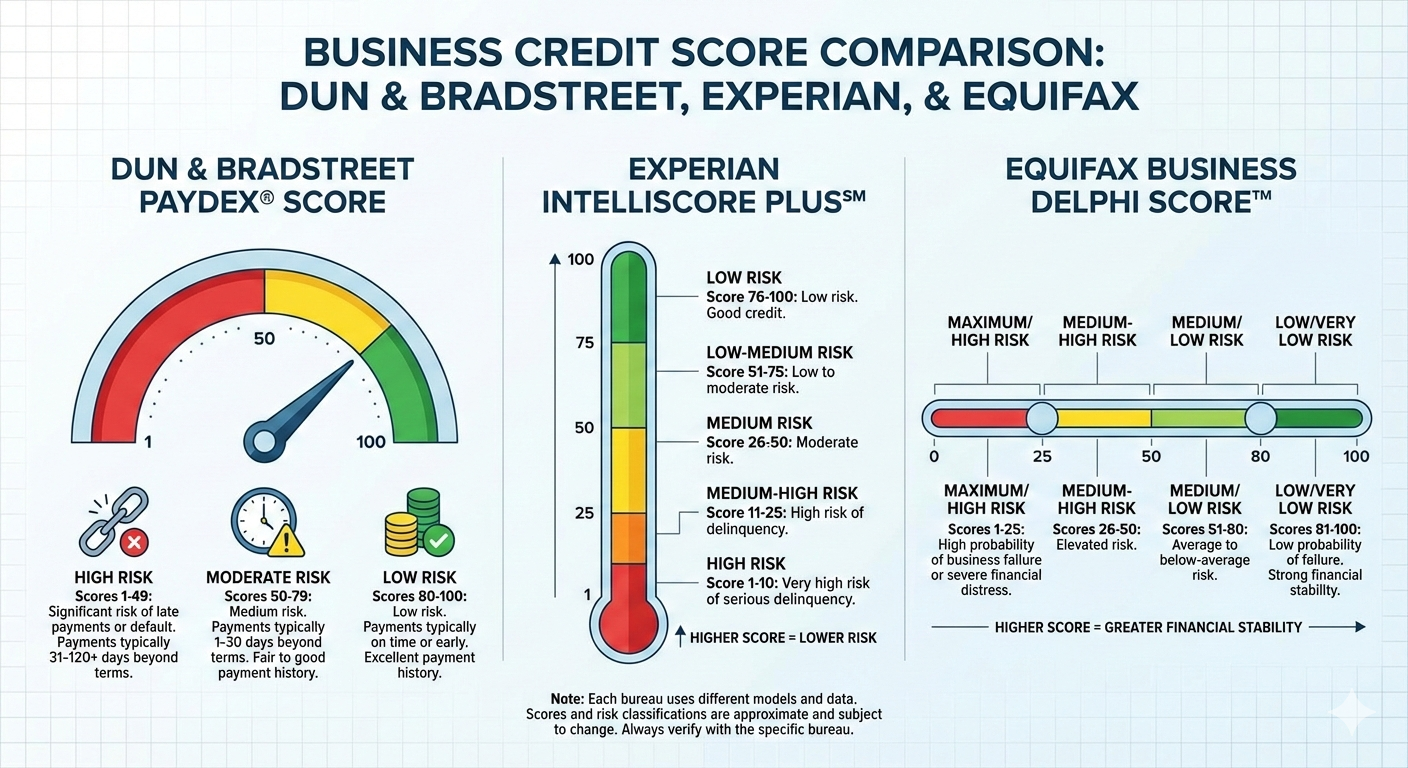
Business credit scoring works much like personal credit but focuses on payment behavior, trade relationships, and debt management. Three bureaus dominate, each with its own model:
- Dun & Bradstreet — the Paydex score (0–100) is built almost entirely on payment timing with vendors that report. 80 means you pay on time; above 80 means you pay early. Many large customers and government contracts check D&B before they check anything else.
- Experian Business — Intelliscore (1–100) blends payment data with public records, collections, and credit utilization.
- Equifax Business — separate payment index and risk scores drawing on banking and vendor data.
Here's the catch most owners discover late: unlike personal credit, business credit only reflects accounts that report. You can pay fifty vendors flawlessly for a decade and have a nearly empty file — because none of them told the bureaus. Building the file is therefore deliberate work, not automatic reward.
Building Corporate Credit Depth — The Five Steps
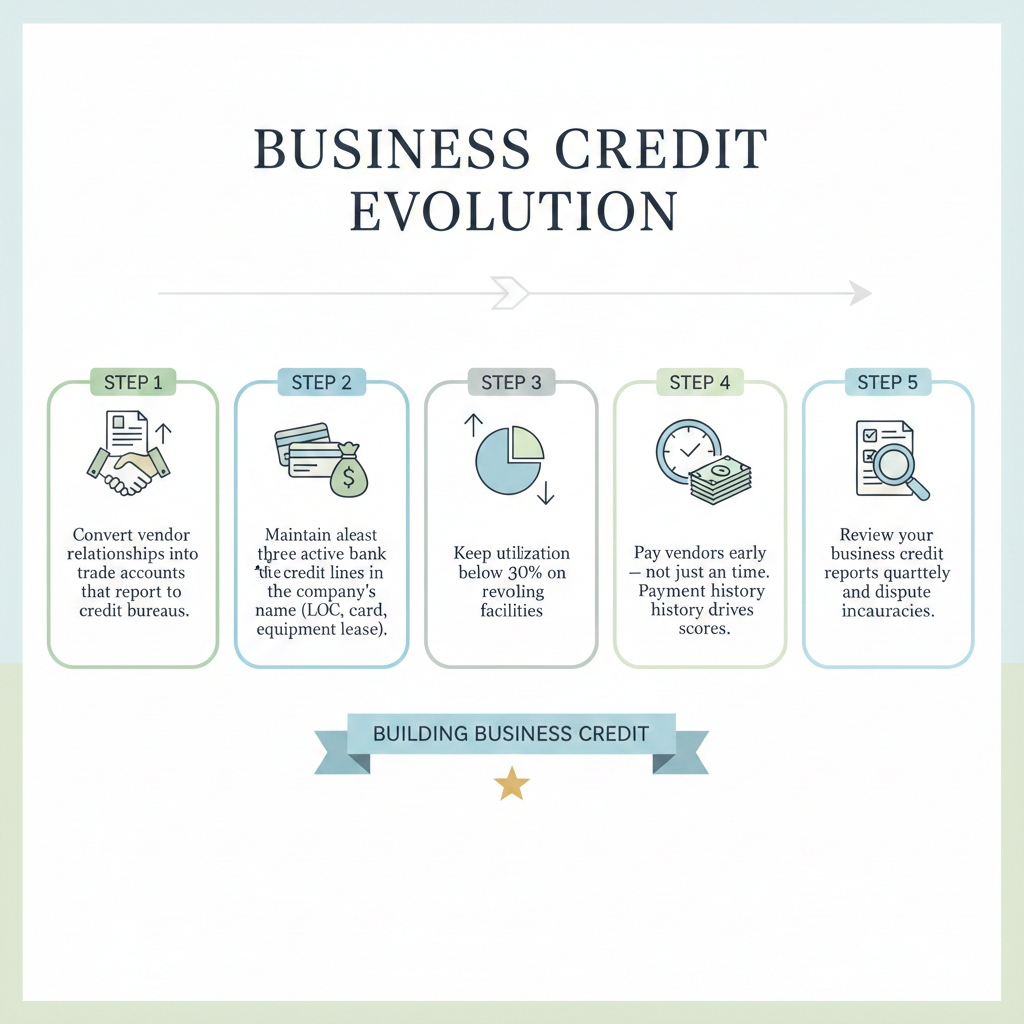
For an established company, building credit is about institutionalizing behavior. You're moving from "bankable because of the owner" to "bankable because of the company." The playbook:
- Convert vendor relationships into reporting trade accounts. Ask your key suppliers for credit terms — and specifically whether they report to D&B or Experian. Prioritize the ones that do. This is exactly what Maria did: she moved her three largest suppliers from cash-on-delivery to net-30 trade accounts that report. It freed roughly $80,000 of working capital (Chapter 4) and built her Paydex at the same time — one move, two wins.
- Maintain at least three active bank credit facilities in the company's name — a line of credit, a business credit card, an equipment loan or lease. Depth means multiple account types performing over time.
- Keep utilization below 30% on revolving facilities. A maxed-out line reads as stress even when it's strategy.
- Pay early — not just on time. Payment history drives every business credit model, and D&B explicitly rewards early payment. The difference between Paydex 80 and 90 is simply days.
- Review your reports quarterly and dispute errors immediately. Business bureau data is messier than personal data — wrong balances, duplicate files, and misattributed collections are common and fixable.
The Personal Side of the File
While the company builds its own identity, the bank is also underwriting you. Expect to provide a personal financial statement (a one-page inventory of what you own and owe personally), personal tax returns, and consent to a personal credit pull. Lenders run global cash flow — combining business cash flow with your personal income and obligations — because in a private company, the two are one economic unit. An owner with heavy personal debt service or thin personal liquidity weakens an otherwise strong deal. The practical advice: manage your personal balance sheet with the same discipline as the company's, and keep personal borrowing modest in the year before a major business request.
Personal Guarantees — and How They Shrink
For commercial loans under $5 million, personal guarantees (PGs) remain standard — but they're negotiable, and their weight diminishes as your company's file matures. In credit committee discussions, I often say: "The goal isn't to eliminate the PG overnight — it's to make it irrelevant." When underwriters see strong credit management, abundant liquidity, and quality financial statements, they rely on the guarantee less — even while it remains on paper.
What Credit Depth Buys at the Top End
At the mid-market level, credit depth separates sophisticated borrowers from transactional ones. When a credit package shows Paydex 85+, DSCR of 1.50, and $1 million in available liquidity, pricing exceptions and term flexibility get approved without drama. That's not favoritism — it's data-driven confidence. Credit is a behavior pattern, and discipline over time earns premium treatment.
Metrics to Monitor Quarterly
| Metric | Where to Check | Target | Cadence |
|---|---|---|---|
| Paydex score | D&B (free or paid monitoring) | 80+ (85+ ideal) | Quarterly |
| Intelliscore | Experian Business | 76+ | Quarterly |
| Revolving utilization | Line + card statements | Under 30% | Monthly |
| Reporting trade lines | All three bureaus | 5+ active | Quarterly |
| Personal FICO (each owner) | Personal bureaus | 700+ | Quarterly |
| Report errors/disputes | All bureaus | Zero open | Quarterly |
The Banker's Perspective
When I present deals to credit committee, I look for businesses that have matured beyond dependence on the owner's personal credit. A strong business credit profile tells me the company is bankable, scalable, and disciplined. Those clients get better pricing, fewer covenants, and faster approvals. Credit strength isn't just risk mitigation — it's leverage in every negotiation you'll ever have with a lender, a supplier, or a buyer.
Key Takeaways
- You have two credit files — the company's and yours. Banks read both; build both.
- Business credit only reflects accounts that report. Building the file is deliberate work.
- Strong business credit lowers your cost of capital — roughly $50,000 on a $1 million, five-year loan in our example.
- The PG shrinks on a ladder: full → capped → springing → released. Climb it with performance and ask at renewal.
- Review reports quarterly; dispute errors immediately. Bureau data is messier than you'd think.
Questions to Ask Yourself
- What are my current D&B, Experian, and Equifax business scores — have I ever actually looked?
- How many of my trade accounts report to the bureaus under my company's name?
- Could my business qualify for financing without my personal guarantee today? What's missing?
- What would global cash flow analysis say about me personally as a guarantor?
- What rate improvement could stronger credit buy on my next loan — and what's my plan to earn it?