The free guide Chapter 7 of 10 ~6 min read
Understanding Collateral and Loan Structures
What lenders accept as collateral, advance rates and LTV, guarantees and recourse, term vs. maturity vs. amortization, and how to negotiate covenants before you sign.
After financing his company's $3 million owner-occupied building, Daniel began evaluating how to finance a $2 million equipment upgrade and expand his $1 million working capital line. His banker explained that at this level, how you structure and secure credit determines flexibility, pricing, and renewal ease. Collateral isn't just protection for the bank — it's leverage for the borrower.
Why Collateral Matters
In commercial banking, collateral drives pricing and structure. Lenders base advance rates on predictable recovery value, not book value — what the asset would actually fetch if things went wrong, sold quickly. Strong collateral reduces perceived risk, which buys lower spreads and more covenant flexibility. Remember the division of labor from the last chapter's pricing discussion: cash flow gets you approved; collateral determines how that approval is priced.
Collateral Types and Advance Rates
An advance rate is the percentage of an asset's value a lender will lend against. The more liquid and predictable the asset, the higher the rate:
| Collateral Type | Typical Advance | Banker Notes |
|---|---|---|
| Cash / CDs | 90–100% | The gold standard — near-riskless recovery |
| Accounts receivable (under 90 days) | 70–80% | Quality matters: customer strength, concentration, aging |
| Inventory | 20–50% | Wide range — finished goods beat raw materials; perishables score lowest |
| Equipment (new) | 70–80% of cost | Titled, movable, and standard equipment recovers best |
| Equipment (used) | 50–75% of appraised value | Based on orderly liquidation value, not what you paid |
| Owner-occupied real estate | 75–85% | The strongest long-term collateral most businesses own |
Loan-to-Value and Collateral Coverage
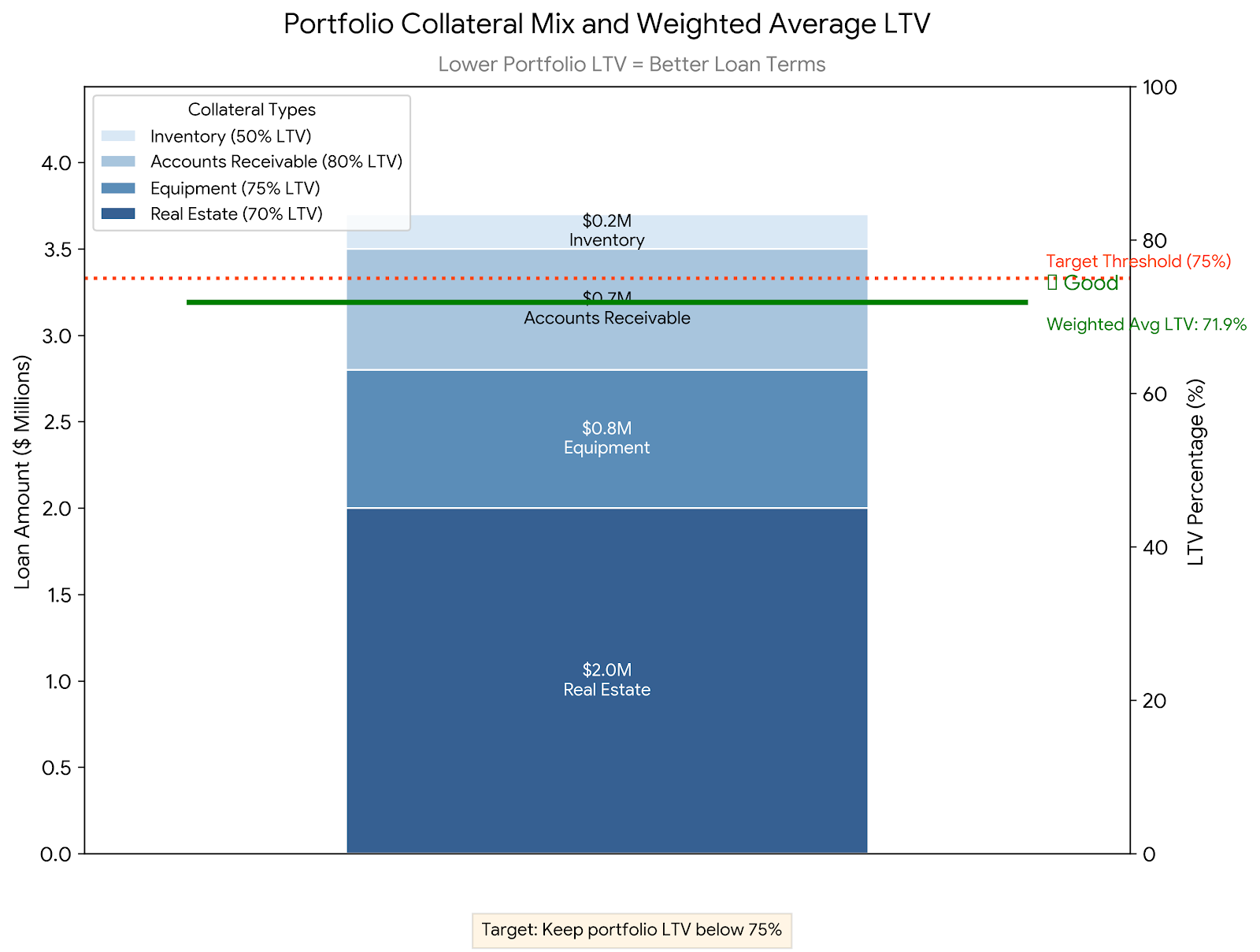
Loan-to-Value (LTV) measures how much of an asset's value a lender finances: Loan Amount ÷ Collateral Value. Lenders also look at portfolio LTV — the weighted average across everything you've pledged. A portfolio LTV under 75% typically earns faster renewals and better terms, because the bank's cushion is visible without a single conversation.
Personal Guarantees and Recourse Structures
Building on the guarantee ladder from Chapter 5 — here's how the recourse levels actually work in loan documents:
- Full recourse: you're personally responsible for all obligations.
- Limited recourse: the guarantee is capped at a specific percentage or dollar amount.
- Springing guarantee: the PG activates only if covenants are violated or default occurs.
For Daniel's $2 million term loan, the initial PG was full recourse. After two years of clean statements and strong repayment history, the bank reduced it to 25% limited recourse — a direct reward for performance and transparency.
Common Loan Structures and Their Use Cases
| Structure | Best For | Typical Shape |
|---|---|---|
| Revolving line of credit | Working capital timing gaps | 12-month maturity, variable rate, annual renewal |
| Term loan | Equipment, expansion, permanent working capital | 3–7 years, fully amortizing |
| Equipment loan / lease | Specific asset purchases | Matches useful life; 80–100% financing |
| Commercial real estate loan | Owner-occupied property | 20–25 yr amortization, 5–10 yr maturity (balloon) |
| Construction-to-perm | Building or major improvements | Interest-only during build, converts to term |
| Acquisition loan | Buying a business or book of business | 5–10 years, often SBA-supported, cash flow lending |
Term, Maturity, and Amortization — Know the Difference
These three terms get used interchangeably, but they mean different things — and the difference is where balloon payments hide:
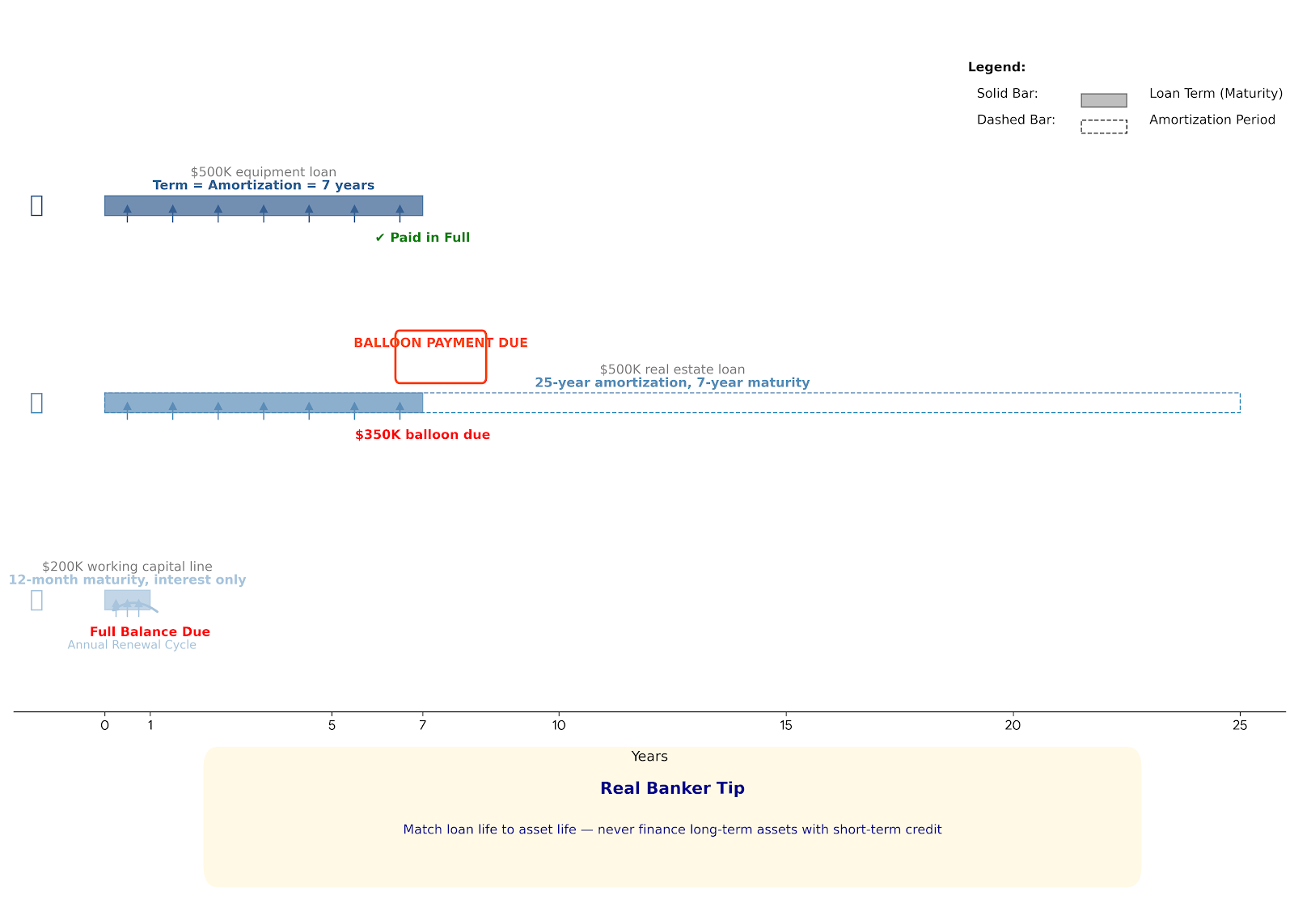
- Term loans usually have matching maturity and amortization — the balance hits zero when the loan ends.
- Real estate loans often amortize over 20–25 years but mature in 5–10. When maturity arrives, the remaining balance — the balloon — must be paid or refinanced. Smart borrowers start the refinance conversation 18–24 months early, while they have leverage.
- Lines of credit are typically 12-month facilities renewed annually; the entire balance is technically due at maturity. Strong borrowers can negotiate 24–36 month commitments.
Covenants: The Rules of the Road
Covenants are the promises in your loan agreement about how you'll run the business while the loan is outstanding. Think of them as the rules of the road, not traps — but rules you should negotiate before signing, because they're nearly impossible to change after.
The common ones in mid-market lending:
- Minimum DSCR — usually 1.20–1.25, tested annually or quarterly. The definition of cash flow (distributions in or out?) matters as much as the number.
- Maximum leverage — a debt-to-equity or debt-to-EBITDA cap.
- Minimum liquidity — a required cash or working capital floor.
- Reporting requirements — statements, agings, tax returns on a schedule. The easiest covenant to keep and the most commonly broken.
- Negative covenants — things you agree not to do without consent: new debt elsewhere, major asset sales, ownership changes, sometimes distribution limits.
When you negotiate, focus on three things: the definitions (how exactly is DSCR computed?), the cushion (set covenants off your worst realistic year, not your best), and the cure mechanics (how long do you have to fix a breach, and what happens meanwhile?). A covenant breach doesn't usually mean the loan gets called — for a communicative borrower it means a waiver letter and a conversation, as Chapter 8 explains. But every waiver is easier when the covenant was set sensibly in the first place.
Maria's Borrowing Base
Maria's line of credit shows how collateral mechanics work in daily life. Her $500,000 line is governed by a borrowing base: she can draw up to 75% of eligible receivables plus 40% of inventory, reported monthly. "Eligible" is the operative word — invoices over 90 days old don't count, and no single customer can exceed 25% of the total. When her biggest grocery chain slowed payments past 90 days, those invoices fell out of the base and her available credit shrank at exactly the wrong moment. The lesson: on an asset-based line, collections discipline isn't just cash management — it's the size of your credit line.
The Banker's Perspective
When I evaluate collateral and structure, I'm assessing how well your borrowing strategy aligns with your business model. Collateral coverage doesn't replace cash flow — it supports it. Strong borrowers manage maturity schedules proactively, align asset life with loan structure, and treat covenants as commitments they helped design rather than fine print they discovered later. That's what separates tactical financing from strategic capital management.
Key Takeaways
- Collateral and structure determine pricing and flexibility; advance rates follow liquidity of the asset.
- Match loan term and amortization to asset life — and calendar every balloon 18–24 months ahead.
- Covenants are negotiable before signing: fight for definitions, cushion, and cure periods.
- On asset-based lines, the borrowing base makes collections discipline equal credit availability.
- PG reduction and lien carve-outs are earned with transparency and performance — ask for them.
Questions to Ask Yourself
- What percentage of my total debt is secured versus unsecured — and by which assets?
- Do my loan maturities align with the useful life of what they financed? Where's my next balloon?
- Which covenant in my loan agreement is tightest against my actual performance right now?
- Have I pulled a UCC search on my own company in the past year?
- What collateral could I leverage more effectively to improve pricing or liquidity?